AI Strategy Is Easy to Write and Hard to Ship. That's Why Axxel Built a Digital & AI (DAI) Lab.
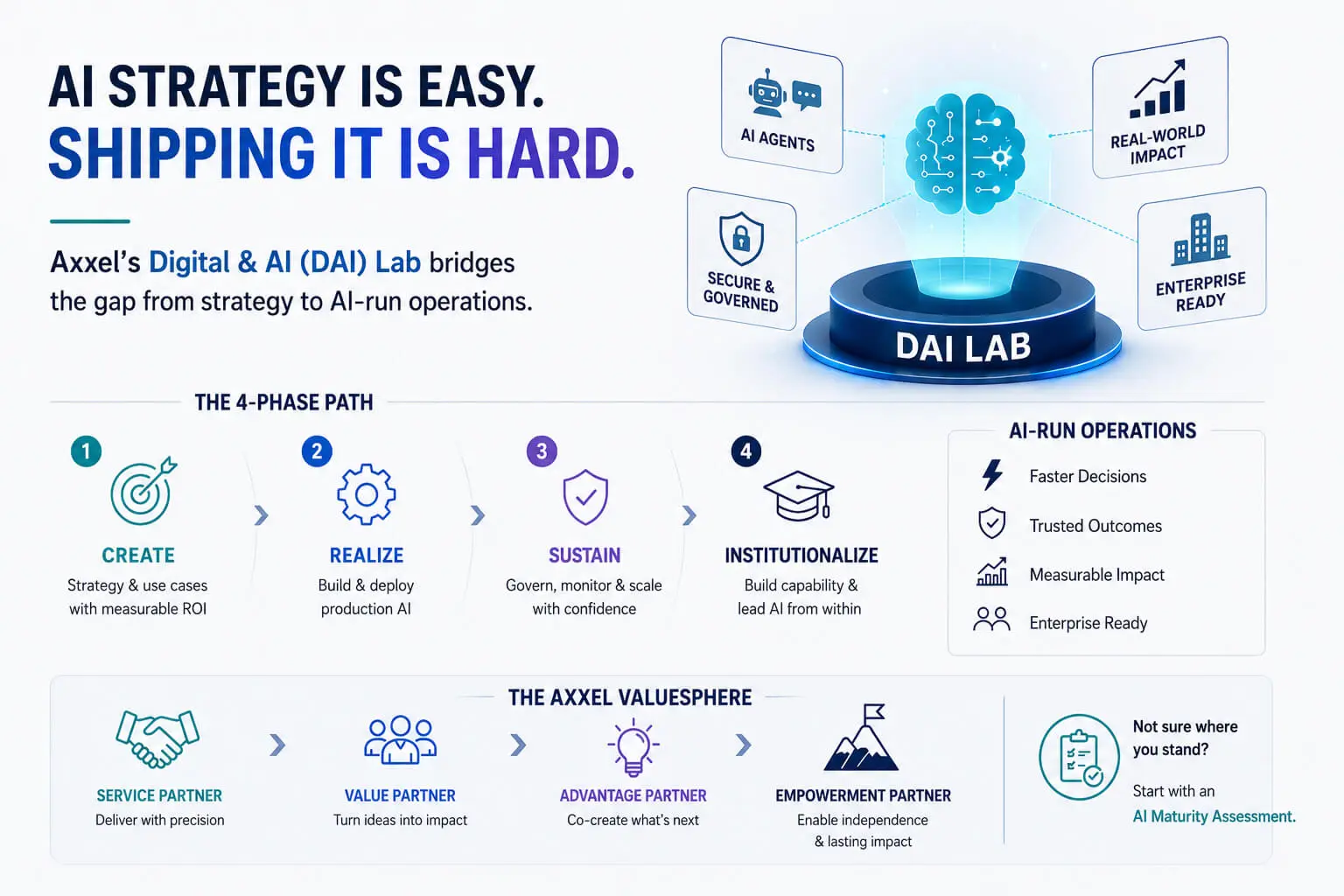
Most enterprises now have an AI strategy document. Steering committee, use-case backlog, a slide with "AI-first" in the title. Far fewer have an AI system running in production that a business team actually depends on. The distance between those two things is a strategy and a shipped, governed, adopted AI capability, where most enterprise AI initiatives quietly stall, and it's rarely a strategy problem. It's a build, govern, and scale problem.
That gap is exactly what Axxel's Digital & AI (DAI) Lab, exists to close.
The gap between an AI strategy and a working AI system
Writing an AI strategy is a few workshops and a consultant's deck. Getting an AI agent into production, one that's integrated with real systems, governed well enough that compliance signs off, and reliable enough that a business team trusts it with something that matters is a different kind of work entirely. It needs people who can prototype fast, who understand the emerging technical patterns (agent orchestration, retrieval, model context protocols) well enough to avoid the expensive dead ends, and who know how to hand a working system to an enterprise IT organization without it collapsing the moment it leaves the lab.
Most organizations don't have that muscle in-house, and most systems integrators built their AI practice by relabeling an existing consulting arm. Axxel took a different approach: build a dedicated DAI Lab, staffed and structured for applied AI from the ground up, rather than asking a data integration team to also become an AI product team on the side.
Axxel's DAI Lab
Axxel's dedicated DAI Lab, built specifically to take enterprises from AI strategy to AI-run operations. Where Axxel's core practice is trusted data, DAI Lab is what gets built on top of that foundation: the applied AI, the modernized applications, and the operating model that lets an enterprise actually run on intelligence instead of just talking about it.
DAI Lab organizes its work around a few connected practices: FutureCraft Advisory sets the strategy — intelligence-led operating models built on domain expertise across banking, life sciences, healthcare, entertainment, and training. AI-First Enterprise Shift operationalizes that strategy into production AI. Digital Reinvention modernizes the legacy applications and platforms an AI strategy usually runs into as a blocker. And underneath all of it sits DAI Lab — the applied research and prototyping engine that turns emerging AI capability into something an enterprise can actually deploy.
Inside DAI Lab: where applied AI gets built, not just discussed
DAI Lab is Axxel’s hybrid innovation lab — a hands-on environment for experimentation, rapid prototyping, and applied AI development inside a secure, enterprise-grade ecosystem. It exists because the fastest way to find out whether an AI use case actually works is to build a working version of it, not to debate it in a steering committee for two quarters.
The lab's work runs through what Axxel calls its AI Immersion Initiative, organized across two tracks. The technical track covers the patterns doing the real work in enterprise AI right now: document AI, autonomous agents, conversational intelligence, agentic AI, predictive analytics and ML modeling, and integration standards like the Model Context Protocol that let AI agents access enterprise data safely rather than through a brittle, one-off connection. The functional track applies those patterns against real industry problems — life sciences, manufacturing, supply chain, financial services, energy trading, healthcare, and education among them — because a prototype that only proves a technology works in the abstract isn't worth much. One that proves it solves a real problem in a specific domain is.
That combination — technical depth paired with domain-specific functional tracks — is what separates a lab that produces demos from one that produces enterprise-ready starting points.
The four-phase path from AI strategy to AI-run operations
For organizations further along, Axxel's AI-First Enterprise Shift practice structures the journey into four phases, each building on the last:
Create — AI adoption strategy. Define the right AI strategy, identify high-value use cases, and de-risk the AI journey around measurable ROI rather than technology for its own sake.
Realize — AI implementation. Design, build, and deploy production-grade AI solutions aligned to the enterprise's actual architecture and business outcomes — not a proof of concept that dies the moment it needs to touch a real system.
Sustain — AI governance as a service. Make sure AI scales safely and responsibly, with clear ownership, embedded controls, and regulatory readiness built in rather than retrofitted after the first audit finding.
Institutionalize — AI Academy. Build the capability to sustain all of this internally: leadership enablement, workforce upskilling, and a functioning AI Center of Excellence, so the organization isn't permanently dependent on an outside team to keep the lights on.
Organizations that aren't sure where they stand on that path can start with our AI Maturity Assessment — a data-backed evaluation of an organization's AI readiness across its current capabilities, data ecosystem, processes, and culture, designed to surface capability gaps and prioritize where the next investment should actually go, rather than guessing.
A partnership model built to deepen, not just deliver
Axxel frames its client relationships through what it calls the ValueSphere — a model built on the idea that the right kind of partnership should get more valuable over time, not just repeat the same engagement. It starts as a Service Partner, delivering with precision and reliability to solve an immediate problem. As trust builds, it becomes a Value Partner, mapping ambitions and priorities and turning ideas into measurable impact. From there it becomes an Advantage Partner, co-creating what comes next instead of just reacting to change. And at its fullest expression, it becomes an Empowerment Partner — where the goal shifts from Axxel doing the work to the client's own people and teams being able to think and act intelligently on their own.
That last stage is worth sitting with. A lot of AI vendors are structurally incentivized to keep an enterprise dependent on them. A practice built around a model that explicitly aims for its own client's independence is a different kind of bet — one that only pays off if the work is good enough that the relationship earns the next stage rather than needing to be re-sold.
Why this sits next to Axxel's data foundation work, not apart from it
None of this works without the layer underneath it. An AI agent is only as trustworthy as the data it's given — which is exactly the argument in this series' earlier article on data quality, governance, and MDM. A golden customer record with no quality rules enforcing it, or an AI agent with unfiltered access to inconsistent data across five systems, produces the same outcome: confident, fast, wrong answers.
That's the connection between Axxel's two practices. Axxel's core data and integration work — the Informatica migrations, the data quality and governance discipline, the validated golden records — builds the foundation an AI system can actually stand on. Axxel’s DAI Lab is what gets built on that foundation: the applied AI, the modernized applications, the governance model that lets it scale, and the internal capability that lets an organization eventually run it without outside help. Enterprises that treat those as two unrelated vendor relationships usually end up with an AI strategy that outpaces the data it depends on. Enterprises that treat them as one connected effort are the ones actually shipping something.
Ready to move from AI strategy to a working AI system?
Axxel's Digital & AI Lab, helps enterprises take AI from strategy to production, backed by the same delivery discipline Axxel brings to its data foundation work.
Talk to our Digital & AI team about your next use case
More insights
Explore more perspectives on enterprise transformation, technology modernization, and business innovation.