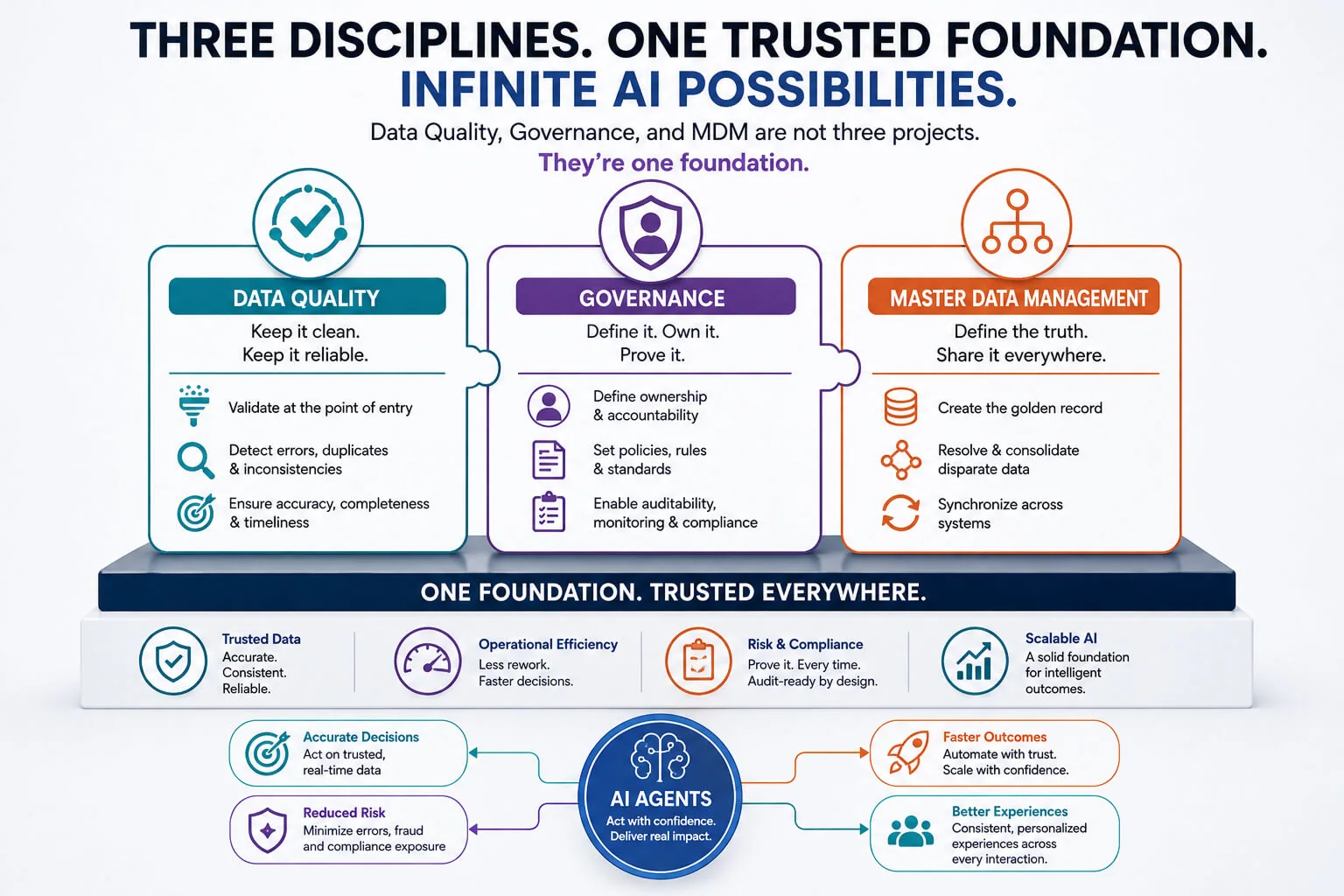
Data Quality, Governance, and MDM are not Three Projects. They're One Foundation.
Sixty-five percent of data leaders believe their employees trust the organization's data enough to use it for AI. Fifty-seven percent, in the same survey, say poor data quality is the main thing keeping AI projects stuck in pilot instead of production. Those two numbers come from the same 600 data leaders, in the same report, published this year.
That gap is the whole story. Most enterprises don't have a data problem they're unaware of, they have a data problem three different teams are separately, partially aware of, using three different tools, reporting to three different budget owners, none of whom has the full picture. Data quality catches bad values. Governance decides who's accountable for them. Master data management decides which version of a record is real. Run as three disconnected initiatives, each one quietly assumes the other two already happened.
They didn't. That's why "we have a data governance program" and "our AI still hallucinates on basic customer facts" turn out to be true at the same company, at the same time.
Three names, one problem
Here's the dependency most organizations miss: master data management can't produce a trustworthy golden record from data no quality rule ever touched. Data quality rules can't be enforced consistently without governance deciding who owns the rule, who can change it, and how you prove it ran. And governance without MDM has nothing concrete to govern. A policy about "customer data" is abstract until there's one authoritative customer record it actually applies to.
Treat them as three separate projects and you get exactly what most enterprises have today: a quality team cleaning data that governance never defined ownership for, an MDM initiative building golden records from sources no quality rule has touched, and a governance function that owns a policy binder nobody operational actually follows. Each initiative can hit its own KPIs and the enterprise still ends up with data nobody fully trusts.
Why 2026 made this urgent, not just important
This has been true for a decade. What changed is who's using the data. Informatica's 2026 CDO Insights survey of 600 global data leaders found generative AI adoption jumped from 48% to 69% of organizations in a single year, and 47% have already moved into agentic AI. AI that doesn't just summarize data, it acts on it. Fifty percent of those leaders named data quality as their single biggest obstacle to deploying agentic AI specifically. Seventy-six percent said their AI governance can't keep pace with how fast employees are adopting AI on their own.
A human analyst looking at a dashboard with a duplicate customer record or a stale vendor address usually notices something's off and asks a question. An AI agent given the same conflicting records doesn't pause, it picks one, books the order, sends the email, or escalates the case, confidently, based on whichever version of the truth it was handed. The agent doesn't create the data quality problem. It just acts on it immediately, at scale, without the sanity check a person used to provide for free.
The market has already priced this in. In November 2025, Salesforce completed its acquisition of Informatica, combining the world's most widely used CRM data with two decades of enterprise data quality, governance, and MDM tooling. Announcing the close, Salesforce CEO Marc Benioff put it plainly: "Data and context is the true fuel of Agentforce, and without clean, connected, trusted data there is no intelligence — only hallucination." That's not a rebrand. It's two of the industry's largest platform vendors concluding that quality, governance, and master data are not adjacent features to an AI strategy, instead they are the prerequisite for one.
What each piece actually does
Worth being precise about this, since the three terms get used loosely.
Data quality is the set of rules and checks that catch bad data at the moment it enters or changes. A malformed email, a duplicate account, an order total that does not reconcile, rather than three reports downstream, after it's already been acted on.
Data governance is who owns a given piece of data, who's allowed to change it, and how you can prove it to an auditor, a regulator, or your own leadership. That the rule you claim to follow is actually the rule that ran. Done well, it's operational discipline: monitoring, audit trails, and accountability built into the systems themselves. Done poorly, it's a policy document nobody operational has read.
Master Data Management is the discipline of deciding, across every system that has an opinion about a customer, product, vendor, or location, which version is the real one and keeping that golden record synchronized everywhere it's used, instead of letting five systems quietly disagree with each other forever.
Put together: MDM decides what's true, data quality keeps it true as it changes, and governance makes sure someone's accountable for both and can prove it.
What it looks like when they are not connected
This shows up constantly in migration and modernization work, which is where Axxel spends most of its time. Every large Informatica environment we have worked in, across industries from healthcare to energy to industrial manufacturing, carries the same signature: a customer record that exists five different ways across five systems because nothing ever reconciled them; a vendor table with active and inactive entries for the same supplier because no rule ever caught the duplicate; SKU attributes that mean something different in the regional system than they do in the corporate one, because "the same field" was governed by two different teams with two different definitions.
None of that is a data quality failure in isolation. It's what happens when quality, governance, and MDM were never designed to talk to each other in the first place. And it does not stay contained, it's exactly the kind of inconsistency that turns a straightforward platform migration into a re-engineering exercise, and exactly the kind of inconsistency an AI agent will act on without hesitation.
A practical framework for connecting them
None of this requires governing your entire data estate before you can start. It requires sequencing the work so each discipline actually supports the others.
- Start with the record that breaks the most things. Don't try to govern everything at once. Pick the domain — customer, product, vendor — causing the most visible downstream pain (duplicate outreach, mismatched billing, conflicting reporting) and build the first golden record there. Scope discipline is what makes the rest of this achievable.
- Put quality rules at the point of entry, not after storage. Catching a malformed record at creation is a rule change. Catching it six months later, after it's propagated into four downstream systems and a dashboard, is a cleanup project. Informatica's IDMC platform added a real-time data quality API in 2025 specifically to move checks to the point of entry rather than post-hoc batch cleanup — the direction the whole industry is moving, for good reason.
- Make the golden record explainable, not just automated. Match-merge logic that silently decides two records are the same customer, with no way to show why, is a governance liability the moment someone asks to see the logic — which, in a regulated industry, they will. Informatica's Claire Match Analysis now provides field-level contribution scores explaining exactly why two records were matched, with the audit trail retained. That's what makes an automated golden record something a compliance team can actually stand behind.
- Build governance into the operations, not a separate document. Governance that lives in a policy binder doesn't survive contact with a live system. Governance that's built into monitoring, audit logging, and change controls — so you can show what happened, when, and who approved it, without asking someone to remember — does. This is where a lot of governance programs quietly fail: they're designed to be read, not to run.
- Validate continuously, especially through any platform change. A golden record and a set of quality rules are only as good as the last time someone proved they still hold. This is the discipline Axxel applies on every migration, at every scale — from a focused 169-asset environment to enterprise estates of 8,000 and 11,000+ assets — because a platform move is exactly when unvalidated assumptions about "the way the data has always worked" get exposed. The same rigor applies whether you're migrating a platform or just changing a matching rule: prove functional parity before you trust production to it.
- Extend it to AI deliberately — don't assume AI agents inherit your governance automatically. A governed database and an AI agent with a general-purpose connection to "the data" are not the same thing. Emerging standards like the Model Context Protocol are specifically about giving agents access to trusted, governed data assets rather than raw, unfiltered access to everything — the difference between an agent that can explain its answer and one that's guessing confidently from whatever it happened to find.
What changes once AI agents are the ones using the data
Everything above matters more, not differently, once agents are involved — but one thing genuinely changes: the cost of a gap goes from "someone notices eventually" to "the agent already acted." A duplicate customer record used to mean a mildly annoying duplicate email. An AI agent working from that same duplicate might approve a discount twice, misroute a support case, or confidently report two different lifetime-value figures to two different stakeholders in the same afternoon — and it will do so with total confidence, because from the agent's point of view, it followed the data it was given correctly.
That's the real argument for treating data quality, governance, and MDM as one foundation instead of three initiatives: the organizations that get there before their AI initiatives scale are the ones whose agents are trustworthy by design. The ones that don't are the ones explaining, after the fact, why an AI agent did something a human never would have.
Ready to connect data quality, governance, and MDM into one trusted foundation? Axxel Technologies helps enterprises turn fragmented data quality, governance, and MDM efforts into one validated, operational foundation on Informatica; the kind AI initiatives can actually stand on.
More insights
Explore more perspectives on enterprise transformation, technology modernization, and business innovation.